

iFCI017
CRICKi012-A
General
iPSC Line |
|
| hPSCreg name | CRICKi012-A |
| Cite as: | CRICKi012-A (RRID:CVCL_C5T4) |
| Alternative name(s) |
iFCI017
|
| iPSC line type | Human induced pluripotent stem cell (hiPSC) |
| Similar iPSC lines |
HIHDNDi001-A (A30P-3, SNCA3, Tue_020_A) Donor's gene variants: SNCA, SNCA, SNCA Donor diseases: autosomal dominant Parkinson disease 1 HIHDNDi001-B (A30P-4, SNCA4, Tue_020_B) Donor's gene variants: SNCA, SNCA, SNCA Donor diseases: autosomal dominant Parkinson disease 1 |
| Last update | 2nd November 2024 |
| User feedback | |
Provider |
|
| Generator | The Francis Crick Institute Limited (CRICK) |
| Owner | The Francis Crick Institute Limited (CRICK) |
| Distributors | |
| Derivation country | United Kingdom |
External iPSC Databases |
|
| BioSamples | SAMEA112233748 |
| Cellosaurus | CVCL_C5T4 |
| Wikidata | Q116048795 |
General iPSC Information |
|
| Publications |
|
| * Is the cell line readily obtainable for third parties? |
Yes Research use: allowed
Clinical use: not allowed
Commercial use: not allowed
Additional restrictions:
the cell line can be obtained by third parties using appropriate MTA |
Donor Information
General Donor Information |
|
| Sex | female |
Phenotype and Disease related information (Donor) |
|
| Diseases | A disease was diagnosed.
|
Karyotyping (Donor) |
|
| Has the donor karyotype been analysed? |
Unknown
|
External Databases (Donor) |
|
| BioSamples | SAMEA112233749 |
Ethics
| Has informed consent been obtained from the donor of the embryo/tissue from which the pluripotent stem cells have been derived? | Yes |
| Was the consent voluntarily given? | Yes |
| Has the donor been informed that participation will not directly influence their personal treatment? | Yes |
| Can you provide us with a copy of the Donor Information Sheet provided to the donor? | Yes |
| Do you (Depositor/Provider) hold the original Donor Consent Form? | No |
| If you do not hold the Donor Consent Form, do you know who does? | Yes |
| Please indicate whether the data associated with the donated material has been pseudonymised or anonymised. | anonymised |
| Does consent explicitly allow the derivation of pluripotent stem cells? | Yes |
| Does consent prevent CELLS DERIVED FROM THE DONATED BIOSAMPLE from being made available to researchers anywhere in the world? | No |
Does consent permit research by | |
| an academic institution? | Yes |
| a public organisation? | Yes |
| a non-profit company? | Yes |
| a for-profit corporation? | No |
| How may genetic information associated with the cell line be accessed? | No information |
| Will the donor expect to receive financial benefit, beyond reasonable expenses, in return for donating the biosample? | No |
| Has a favourable opinion been obtained from a research ethics committee, or other ethics review panel, in relation to the Research Protocol including the consent provisions? | Yes |
| Name of accrediting authority involved? | This project has been approved and monitored by [19/LO/1796] and collaborates with researchers from around the world. |
| Approval number | 19/LO/1796 |
| For generation of the cell line, who was the supplier of any recombined DNA vectors or commercial kits used? | |
iPSC Derivation
General |
|
| Source cell type |
Synonyms
|
Reprogramming method |
|
| Vector type | None |
Vector free reprogramming |
|
| Type of used vector free reprogramming factor(s) |
mRNA
|
| mRNA | |
Other |
|
| Selection criteria for clones | MANUALLY PICKED (iPSC MORPHOLOGY) |
| Derived under xeno-free conditions |
No |
| Derived under GMP? |
No |
| Available as clinical grade? |
No |
iPSC Culture Conditions
| Surface coating | Matrigel/Geltrex |
| Feeder cells |
No |
| Passage method |
Enzyme-free cell dissociation
Gentle Cell Dissociation Reagent
|
| O2 Concentration | 5 % |
| CO2 Concentration | 5 % |
| Medium |
mTeSR™ 1
|
| Has Rock inhibitor (Y27632) been used at passage previously with this iPSC line? | No |
| Has Rock inhibitor (Y27632) been used at cryo previously with this iPSC line? | No |
| Has Rock inhibitor (Y27632) been used at thaw previously with this iPSC line? | Yes |
iPSC Characterisation
Analysis of undifferentiated iPSCs
iFCI017 FLOW FINAL FIGURES.png
Flow cytometry showed markers for OCT4 and SSEA-4 were detected, while SSEA-1 was not detected.
Differentiation Potency
In vitro spontaneous differentiation
In vitro directed differentiation
Scorecard
Morphology
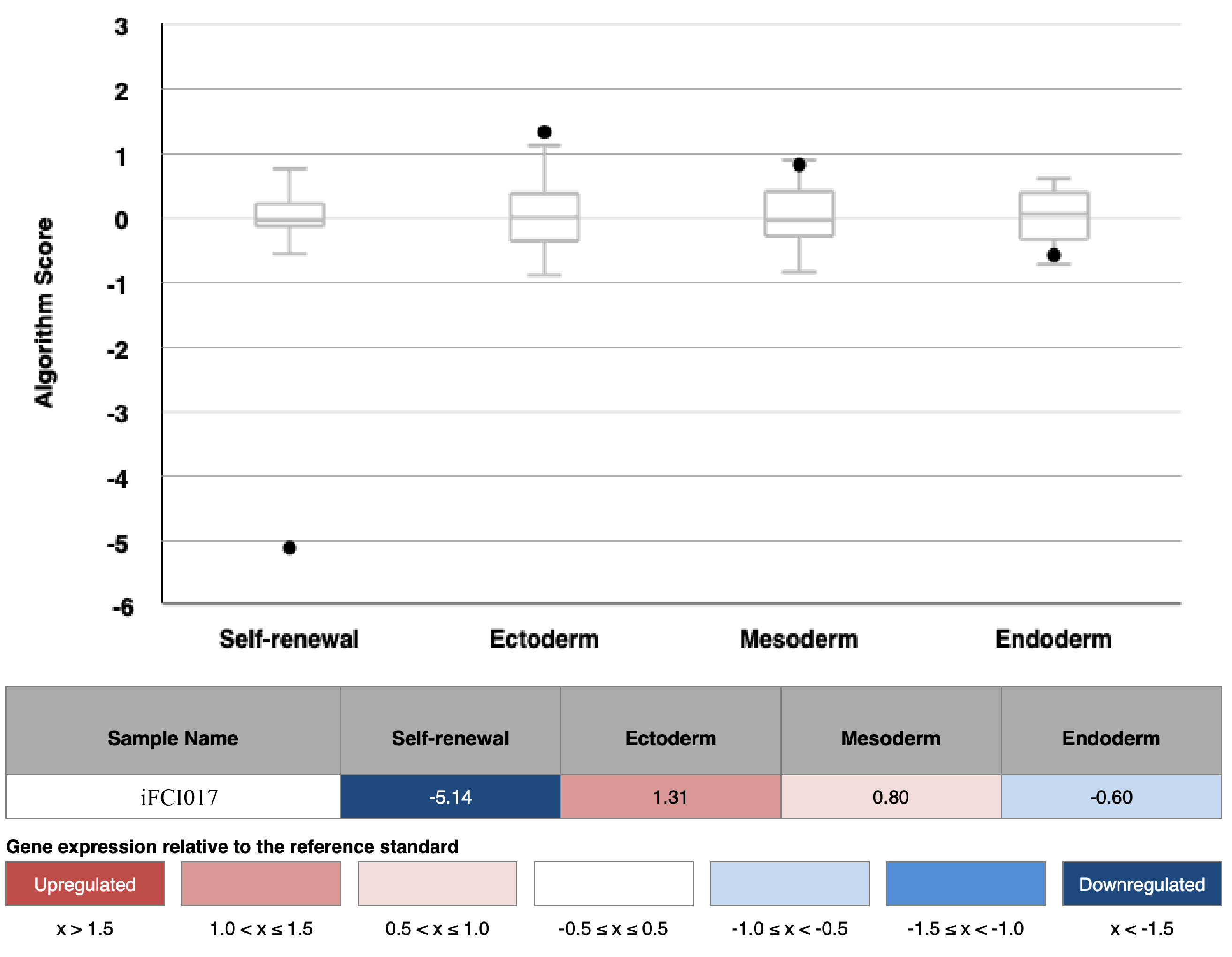
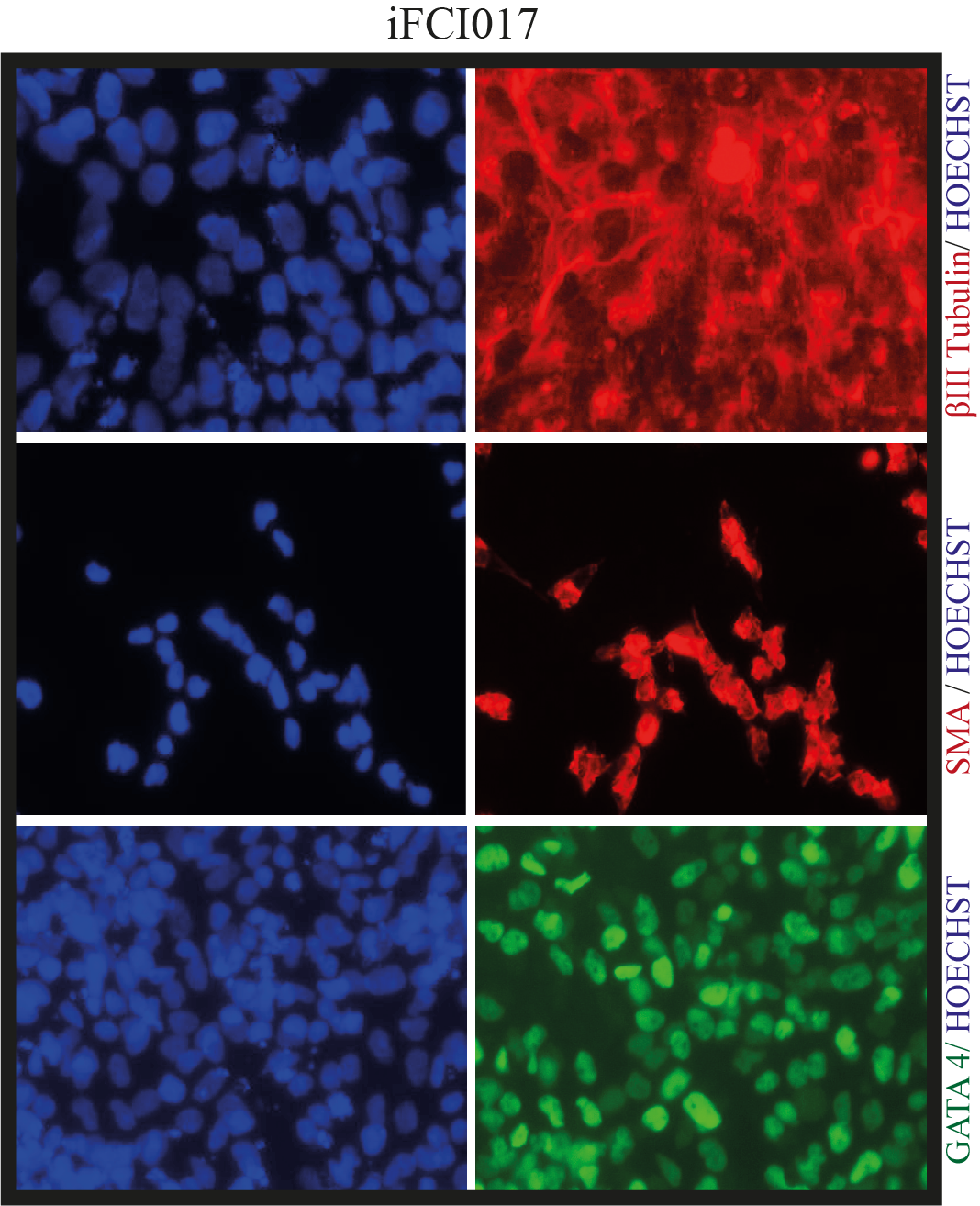
In vitro spontaneous differentiation
In vitro directed differentiation
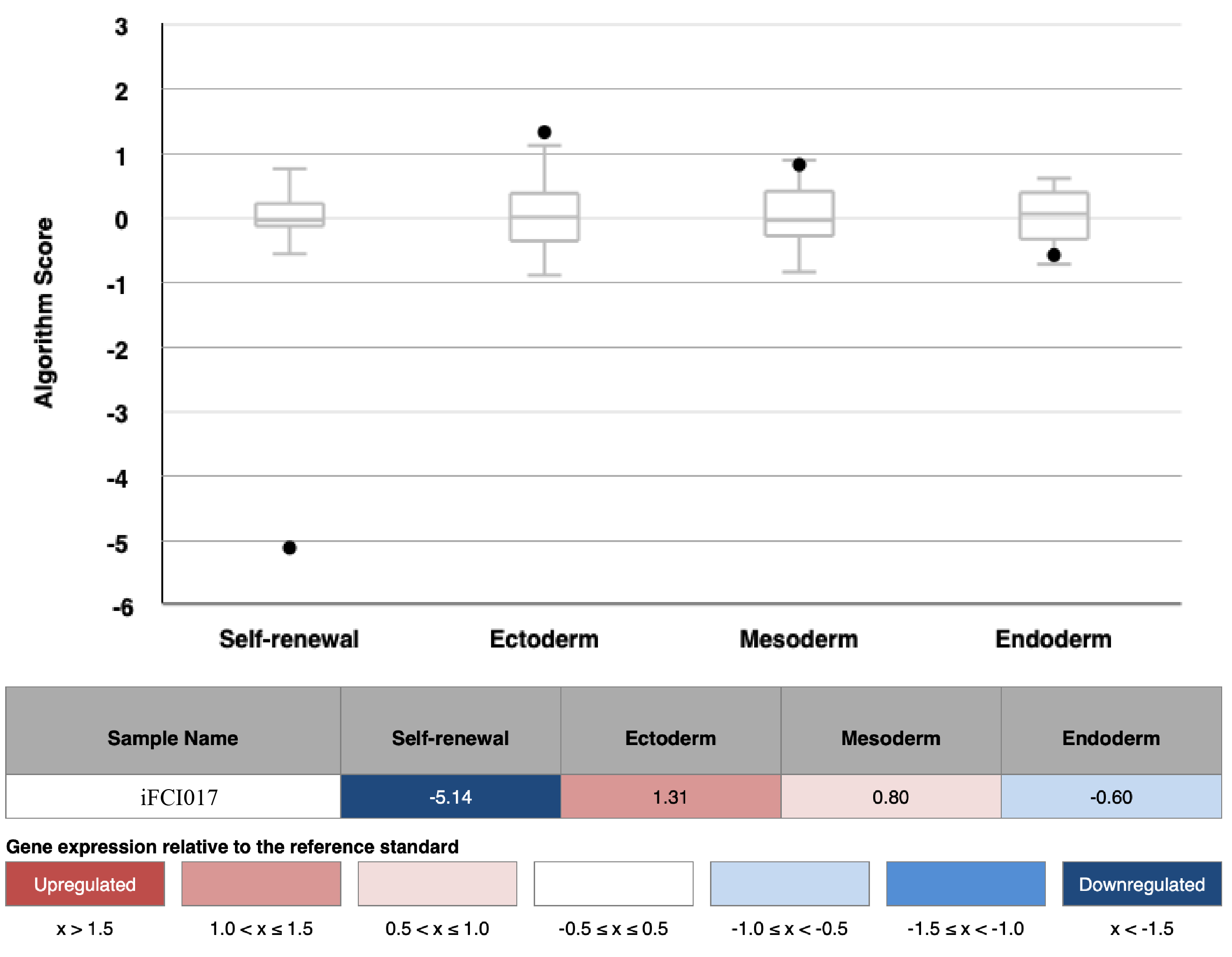
Scorecard
Morphology

In vitro spontaneous differentiation
In vitro directed differentiation
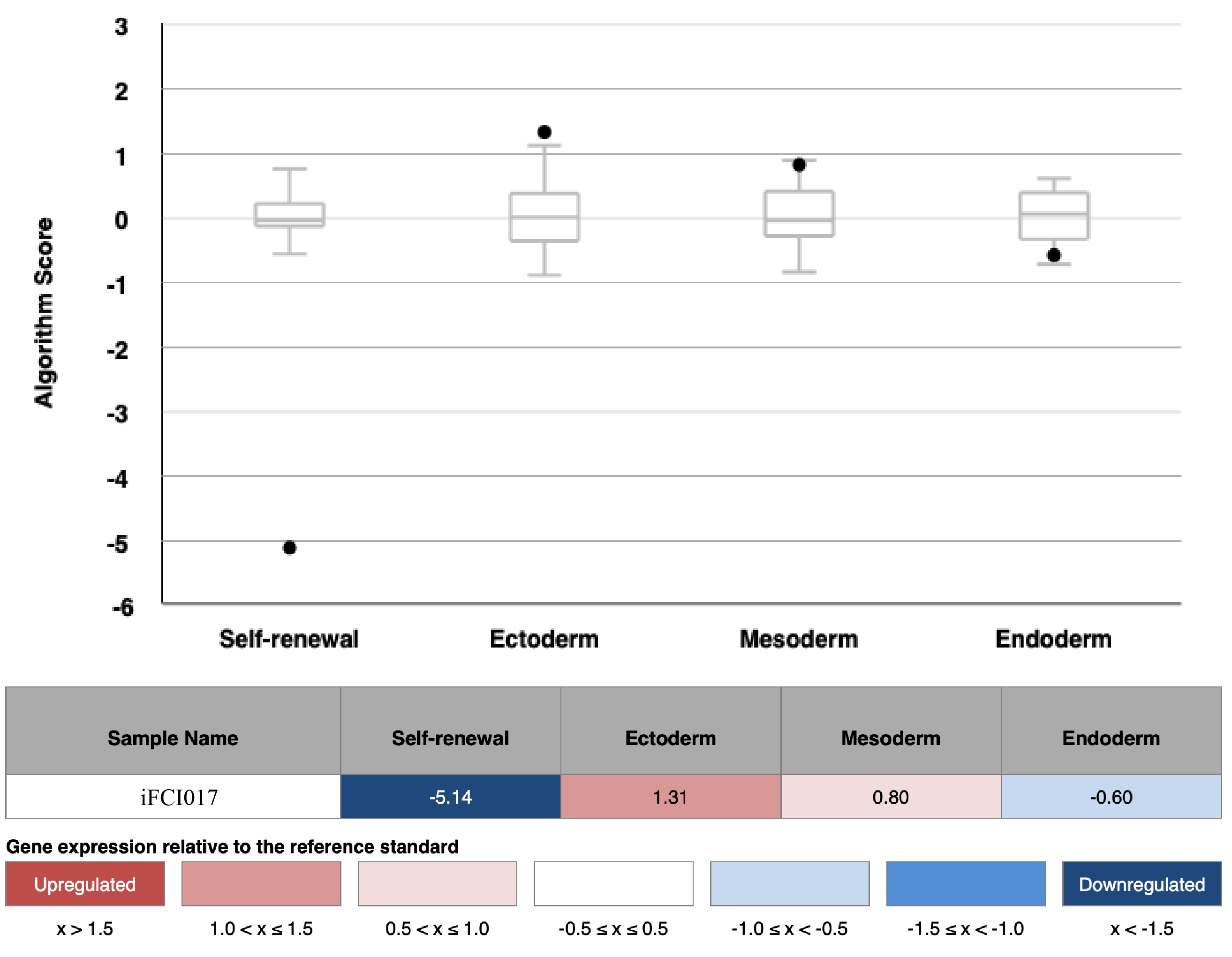
Scorecard
Morphology

Microbiology / Virus Screening |
|
| Mycoplasma | Negative |
Genotyping
Karyotyping (iPSC Line) |
|
| Has the iPSC line karyotype been analysed? |
Yes
|
Other Genotyping (iPSC Line) |
|
Login to share your feedback, experiences or results with the research community.